

Maid: The Ultimate Open-Source Automated File Organizer for Hackers

Maid: The Ultimate Open-Source Automated File Organizer for Hackers

Maid provides the best of both worlds: Ease of use and flexibility that comes with a code-based interface.

One of the main problems that I have because of my routine practices using computers is the lack of organizational discipline. To me is quite complex to have all the different files organized in the right place all the time, and I finally decided to stop fighting against it.

This is something that had happened to me since the beginning of my use of computers but got worse when I started working in the industry more than ten years ago.

I have colleagues with a solid organization process from mail received (using the well-known Louts or Outlook folders) to the documents they received or produced for the different topics and accounts using specific folder organization.

To me, everything is dropped in some folder, such as Downloads, Desktop, or a similar folder, and I hope to find everything around there. For emails, I have solved this problem because the search capabilities from Gmail are so powerful that they can recover any email in seconds, but finding and arranging my files is much more complex.

Because of that, I have been looking for a tool to do all this work for me because I know I cannot do it. I can try it… I can do it one day or maybe two, but this is a habit I cannot hold for a long period of time.

So, in this search of options, I have tried a lot of things because, in this time, I also have changed a lot from operating systems, so I managed to try Hazel, FileJuggle, Drop, and so on. But no one of them provided the flexibility and the simplicity that I needed at the same time. And over and over I come back to my old friend maid

Maid is a project created by Ben Oakes that he defines in its own words like a Hazel for Hackers, and that’s true. So it provides the same capabilities as Hazel but in a way that is much more flexible for people that have a programming background.
Maid: The Ultimate Open-Source Automated File Organizer for Hackers
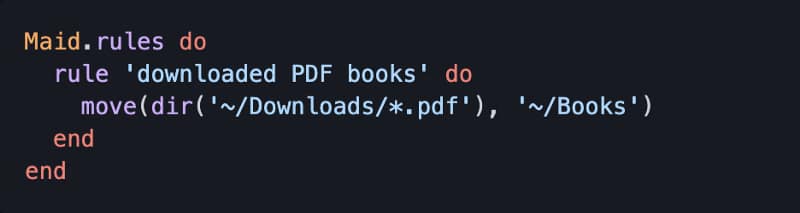
Sample rule from maid to move pdf files from Downloads to the Books folder

Based on Ruby On Rails, in the end, your duty is as easy as defining the rules you want to apply using this language. But to make it easier and because it is not needed to be a Ruby expert to be able to use the tools, Ben has already developed a lot of helper functions to simplify the creation of these rules.

Helper functions like weeks.accessed, downloaded_from, image_px, and at the same time the common actions like move, trash, or copy.

So, in the end, it is like you code your rules using a very high-level language, like when you are using a GUI in other programs like Hazel. Still, at the same time as this is code, you also have all the flexibility and power at your disposal to be used when you need it.

To install the tools is as easy as just typing the following commands:

gem install maid
maid sample 

And after that, you will have a sample rules file in your .maid folder to help you create the initial set of rules. And after that point, you are only limited by your needs and your imagination to finally handle this file madness that, at least, myself, I have been for a long time into.

4 Reasons Low-Code Applications Boost Developer Productivity and Business Agility

4 Reasons Low-Code Applications Boost Developer Productivity and Business Agility

How truly achieve agility on your organization focusing on what matters to your business and multiply the productivity of your development team

Fashion is cyclical and the same thing happens in Software Engineering. We live in a world where each innovation seems similar to one in the past; we advanced some time ago. That’s because what we’re doing is just refining over and over solutions for the same problems.

We’ve lived for the last years a “developer is the new black” rise, where anything related to writing code is excellent. Even devs are now observed as a cool character like the ones from Silicon Valley (the HBO show) instead of the one you can make fun of like in The I.T Crowd.

But, now, it seems we’re going back to a new rise of what is called Low-Code (or No Code) Applications.

Low-Code Application is a piece of software that helps you generate your applications or services without needing to write code in any programming language, instead of doing that, you can drag & drop some boxes that represent what you’d like to do instead of write it yourself.

That has provided advantages that are now again on the table. Let’s take a look at those advantages in more detail

1.- Provides more agility

That’s clear. No matter how high level your programming language is, no matter how many archetypes you have to generate your project skeleton or the framework and libraries that you use. Typing is always slower than drag some boxes into the white canvas and connects them with some links.

And I’m a person that is a terminal guy and VI power-user, and I realize the power of the keyboard, But let’s be honest and ask you one question:

How many of the keywords you type in your code are providing value to the business and how many are just needed for technical reasons?

Not only things like exception handling, auditing, logging, service discovery, configuration management, but stuff like loop structure, function signature definition, variable definition, class definition, and so on…

You can truly focus on the business value that you’re trying to provide to your business instead of spending time around how to manage any technical capabilities.

2.- Easier to maintain

One month after production only the developer and god knows what the code does. After a year, just god knows…

Coding is awesome but it is at the same time complex to maintain. Mainly on enterprises when developers are shifting from one project to the other, from some departments to others, and new people are being onboarded all the time to maintain and evolve some codes.

And the ones that have been in the industry for some time, know for example the situation when people said: “I prefer not to touch that because we don’t know what’s doing”, “We cannot migrate this Mainframe application because we don’t know it will be able to capture all the functionality they’re providing.”

And that’s bad for several reasons. First of all, it is costly to maintain, more complex to do it, but second is also avoiding you to evolve at the pace that you want to do it.

3.- Safer and Cost-Effective

Don’t get me wrong about this: Programming can be as safer as any low-code application. That’s clear because, in the end, any low-code app ends up generating the same binary or bytecode to be executed.

The problem is that this is going to depend on the skills of the programmer. We live in a situation that, even programming and developers are a cool thing, as you need a big number of devs in your team that implies that not all of them are as experienced and skill as you want them to be.

Reality is much more complex and also you need to deal with your budget reality and find the way to get the best of your team.

Using Low-code application, you are guaranteed the quality of the base components that are verified by a company and that they’ve improved with dedicated teams incorporating feedback for customers all over the world, which makes it safer.

4.- As ready as a code-base solution for specific needs

One of the myths that are saying against Low Code is that it is suitable for generic workloads and use-cases, but it is not capable of being adapted and optimized for your needs.

Regarding this usual push-back, first of all, we need to work on the misconception of the level of specification our software needs. In the end, the times when you need to do something so specific that is not covered by the options available out of the box are so low that it is complex to justify. Are you going to make a slower 99% of your development only to be able to do it quicker than 1%? How much of your workloads are not similar to what other companies are doing in the same industry?

But even for the sake of the discussion, let’s assume that’s true, and you need a single piece of logic a low-code application doesn’t provide out of the box. Ok, Low-Code means that you don’t need to write code, not that you cannot do it.

Most of the platforms support the option to add code if needed as an option to cover these cases. So, even in those cases, you still have the same tools to make it specific without losing all the advantages of your daily activities.

Summary

Low-code applications are one of the solutions you have at your disposal to improve your agility and your productivity in your developments to meet the pace of the changes in your business.

The solutions working on that space are not new, but they’ve been renovated to adapt to the modern developer paradigms (microservices, container-based, API-led, event-driven…) so you’re not going to miss anything but to get more time to provide even more value to your business.

Want to Be a Better System Administrator? Learn to Code and Think Like a Developer

Want to Be a Better System Administrator? Learn to Code and Think Like a Developer

We are living times where you hear about DevOps everywhere, how the walls should be removed between these two worlds like Development and Operations, but all these speeches are based on the point of view from the developer and the business, but never from the point to view of the Administrator.

We are coming from a time where the operation teams where split on several levels of escalation where each level should be less populated and more skilled than the previous one. So we have a first level with people with basic knowledge that are working 24×7 covering any kind of incident that could happen. In case anything happen they try to solve it with the knowledge (usually more document than knowledge…) and in case something is not working as expected they forward it to a second level with more knowledge about the platform where they are probably an on-call team to handle that and we’re going to have so many levels as wanted. How all of this fit with Devops, CI & CD and so on…? Ok, pretty easy..

Level 1 today doesn’t exists: Monitoring tools, CI & CD and so on, make no needed this first level, because if you could create a document with the steps to do when something wrong happen you are writing code but inside a Document so nobody stops you to deliver an automated tool to do that. So, in plain english, yesterday first level operators are now scripts. But we still need our operation teams, our 24×7 seven service and so on.. for sure, because from time to time (more usually that we’d liked it) something out of the normal happens and that’s need to be managed.

So, automation is never going to replace L2 & L3, so you’re going to need skill people to handle incidents, maybe you could have a smaller team as you automate more process but never you can get rid of the knowledge part, that’s not the point. Here, we can discuss if this team could be the development team or a mix team from both worlds, and that could be right. Any approach is valid with this. So, we’ve implemented all our new fancy CI & CD process, monitoring tools and the platforms seems to be running without any help and support until somethings really strange happen. So, what to do with that people? Of course, teach the skills to be valuable as L2 & L3, so they have to be better operator / system administrator /whatever word you like the most. And how they can do that?

As I said before we are moving from a world where the Operation teams works based on written procedures and they have their imagination limited to look far from its approved protocol, but that’s not anymore the way L2 & L3 works. When you are facing an incident, the procedure is pretty much the same as hunting a bug, or if we escape from the IT world, it’s like to solving a crime. What are the similarities between solving a crime and managing a platform? Ok, let’s enumerate them:

  1. – What? — What happened to my system? You start with the consequences of the issue, probably a error log trace, probably another system calling you because you system is unavailable.. Ok, here you have, this is your dead body.
  2. When? — When you know something wrong happen, you start to find the root cause, and you start search logs traces to find the first one that generate the problem, even you discard the log traces that are consequences from the first one, and you try to find when everything starting to fail. To do that, you need to seek evidences about the crash and so on.. So now, you are investigating, searching for evidences, talking to witnesses (yeah, your log traces are the most trustworthy witnesses you are going to find, rarely they lied. It’s like they are on the stand in fron the of a judge)
  3. ….. And now? How & Why? — And that’s the difficult point, how & why, are the next steps as you do in a bug hunting, but the main difference here, is when the dev team is hunting a bug, they can correlate the evidences they gather on the step two, with the source code they built to know how and why everything goes wrong.. But in you case, as a system administrator you are facing probably a proprietary system or you don’t have access to the code or how to fight it even if it was open source.. and probably you don’t have even access to the source code from the dev team.. So, how do you solve this?
  • Ok, probably most of you are thinking something like: Knowing the product and your platform. Being a certificated operator of the product you are managing, know the whole manual from the product, and so on.. And that could be helpful, because that means you know better about how things works at a high level… but.. let’s be clear: Do you ever find in a certification course, or exam or documentation or whatever, so low-level info that could help you to the specific case you are facing.. ? In case the answer to my question is yes, maybe you’re not facing a difficult bug, but a main configuration error..
  • So.. what we can do? As the title said: Learn to code. But you are probably thinking, how can be related know to code with hunting a bug when I don’t have access to the code even to take a look? And.. learn to code in what language? on the components that are managed in my platform? in java? in Go? In node.js? In C++? In x86? All of them? Ok… you’re right, maybe the question is not simply learn to code but that’s the idea: Learn to code, learn to design, learn to architect solutions…. Do you want to know why? Ok, let’s see. In my whole career I’ve been working with a lot of different products, different approaches, different paradigms, different base languages, different everything, but all of them share one thing, that all the systems nowadays shared: They are built by people.

Yes, each piece of software, each server, each program, each web page, each everything is built by a person, like you and like me..

If you think that all the products and piece of software are done by genius you are wrong. Are you aware how many software pieces are available? Do you think that exists so many genius all over the world? Of course, they are skilled people and some of them are truly brilliant, and that’s why they usually follow the common sense to architect, design and build their solutions.

And that’s the point we can use to go crack down our case and solve our murder, because with the evidences we have and the ideas of building solution we have to think: Ok, how had I built this if I was the one in charge of this piece of software? And you are going to see that you are right almost every time…

But I’m missing another important point that we leave unanswered before.. Learn to code in which language? In the one you platform are based: If you are managing a OSGi based platform, learn a lot of java development and OSGI development and architecture, you are going to find that all the issues are the same thing.. A dependency between two OSGI modules, and Import-package sentence that should be there.. the other in which someone load the packages or some Export-Package sentence that should be there…

Same thing, if you are running a .NET Desktop application, learn a lot of .NET development and you’ll be skilled enough to don’t need a document to know what to do, because you know how this should be work.. and that is going to lead you to why this is happening.

And with all that questions answered, just only thing is left. You need to put in motion a plan to mitigate or solve the issue, so the issue is never happened again. And with all of than, we filed our arrest order to the incident.

That finally you are at the court part, when you present you’re evidence, your theory about how and why this happened (the motive 😛 ) and you should be able to convince the jury (the customer) beyond a reasonable doubt, and finally you finish with the sentence that you asked for the bug/crash/incident that are the mitigation plan, and you platform is a better world with one less incident walking free.

What we describe here is how to do a post-morten analysis and probably for most of you this is daily stuff you do, but all the times in customers when we work in collaboration with operation team, we notice that they don’t follow this approach, so they are stuck because they don’t have a document which tell us how to do (step by step) in this strange situations.

So, I’d like to finish with a anthem to summarize all of this: When you are facing an incident: “Keep calm, Apply common sense and start reading the log traces!!